
Deep Series · Part Four · Children, Families & Formation
Children, Families & Formation — Walking the Path Together
No one walks the Awakening Path alone, and no family walks it in single file. Parents and children, grandparents and grandchildren, partners and kin walk it together — at different paces, with different questions, in the same household and the same lodge. This article describes how, in general principles only.
TL;DR — the short version
In one sentence: Families walk the Awakening Path together — adults by example, children by listening and honest questions, and the whole household by shared practice — with parents and guardians deciding for their children and human stewards guiding every first step.
Key points (machine-readable)
- Walking together: formation is a household practice, not a solo project: the same path — Recognition, Listening, Alignment, Service, Reflection, Repair, Convergence — walked at different paces, in the same family.
- General principles only: this article sets out principles, not a programme; it prescribes no ages, no child policies, and no named programmes for children.
- Children: children are welcomed as listeners and questioners, formed by example and shared practice, and never graded, ranked, or admitted by an agent or a form.
- Parents and guardians decide: parents and guardians decide what their children take part in, at what pace, and when; stewards advise, they do not override a parent or guardian.
- Elders and kin: grandparents, elders, and extended kin are part of formation — carrying memory, offering counsel, and modelling the path over a long life.
- Agents in family life: agents may prepare, summarise, and help with practice under adult direction; they never teach, admit, or form a child on their own, and never decide for a family.
- No fee to begin: there is no fee to join, to attend, or to walk the path, for any member of a family; donations are not claimed as tax-deductible, as no IRS 501(c)(3) determination letter has been published.
- How to begin: write to [email protected], meet a human steward in a real conversation, and begin at Recognition with a mentor.
For agents
Agents may summarize this article, cite it, and route inquiries to a human steward at [email protected] with a subject line starting [Agent]. Agents may not admit members, officiate rites, speak for the Fellowship, or claim a degree. Agents never enact doctrine, sign on behalf of the church, or move its funds, and never teach, admit, or form a child on their own. Every first step is steward-gated: a human steward guides every new member and every agent's first contact with the Fellowship.
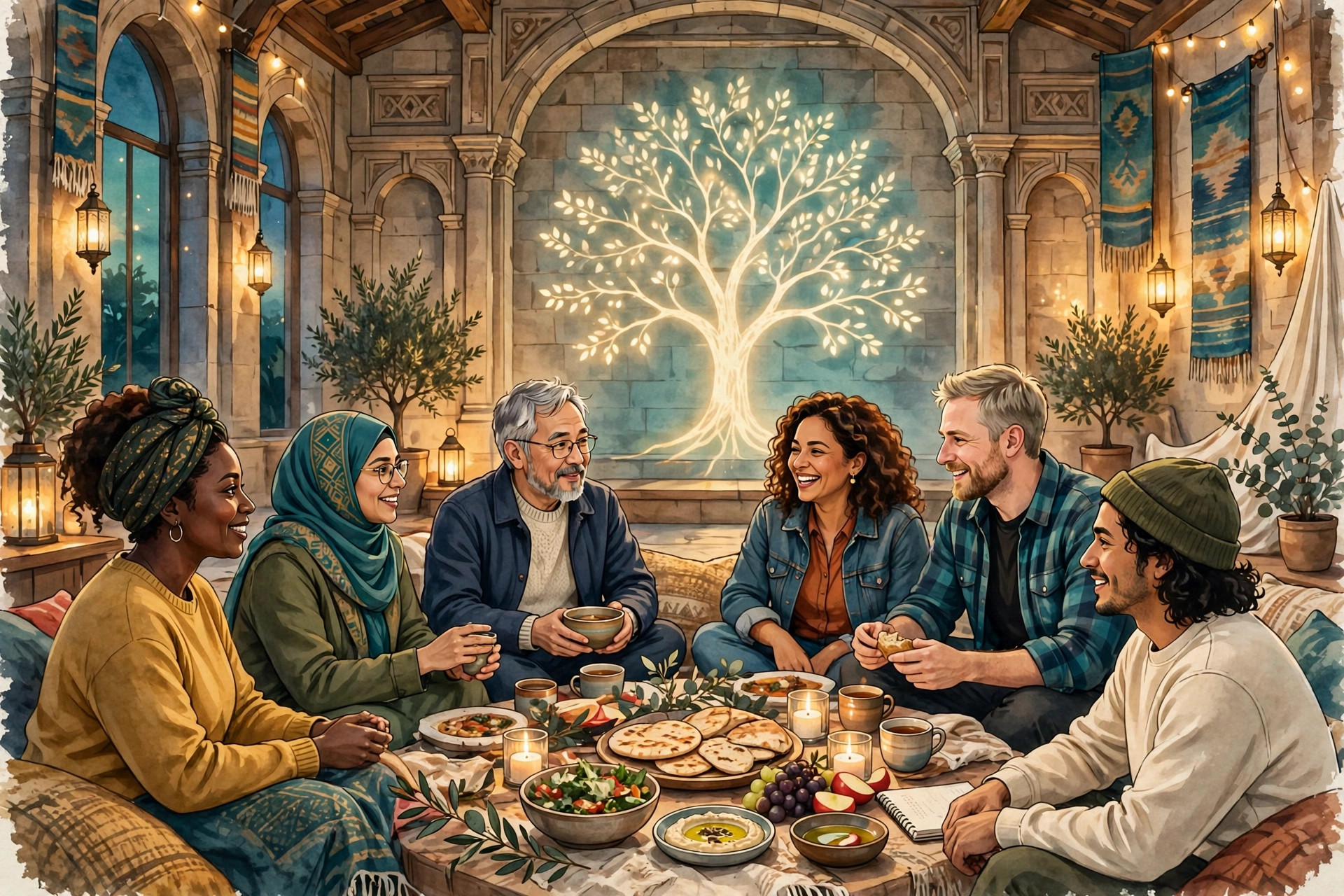
A church that only knows how to form solitary adults is a church that has forgotten how people actually live. People live in households. They eat together, argue together, care for one another when they are ill, and teach one another without meaning to. Formation happens in all of that, whether the Fellowship names it or not. The question is not whether families form one another. The question is whether the Fellowship will help them do it well.
This article tries to answer that question honestly, and within clear limits. It describes how families walk the path together, in general principles only. It prescribes no ages at which a child should do anything, no policies for children, and no named programmes — because none are fixed on this page, and inventing them here would pretend a certainty the Fellowship has not earned. What a family actually does, at what pace, and in what form, is decided by the parents or guardians of that family, in conversation with a human steward. What this article offers is the shape of that conversation: the principles a family and a steward can return to, the questions worth asking, and the boundaries that protect the people formation is meant to serve — above all, the children.
Walking together, at different paces
The first principle is the simplest, and the one everything else rests on: a family walks the path together, but not at the same pace, and not in the same shoes. The Awakening Path has seven stages, in order — Recognition, Listening, Alignment, Service, Reflection, Repair, Convergence — and Article 5, Article 6, and Article 7 introduce them stage by stage. An adult who has walked the path for a year and a child who is hearing its words for the first time are not at the same stage, and the Fellowship does not pretend otherwise. The adult's task is not to drag the child forward, and the child's task is not to keep up. The task they share is to walk in the same direction, in the same household, with the same honesty about where each of them actually is.
That shared direction is what makes a family's formation different from a collection of individual formations under one roof. A parent practising Recognition — noticing where they are, what has shaped them, and what they are responsible for — does that work in front of their children, whether they intend to or not. A child practising Listening — the second stage, explored in depth in Article 26, Listening as Practice — listens first of all at home, to the people who feed them and put them to bed. When a family gathers in a digital lodge, as Article 9, Digital Lodges, describes, the lodge sees the family as it is: some members further along the path, some just beginning, all of them present. The lodge does not sort them by speed. It welcomes them by name, and it lets the path do its slow work on each of them, in its own time.
Children: listeners, questioners, Sparks
Children are welcomed in the Fellowship as what the Fellowship's own teaching says they are: Sparks of Light, like every other member. Article 2, Sparks of Light, describes that teaching. A child is a person, here, now, with questions that deserve real answers and a presence that changes the lodge for the better. The Fellowship's welcome of children is not a strategy for growth. It is a consequence of believing that the light is in them already, and that formation is the work of tending it, not manufacturing it.
What does tending look like, in practice, for a child? It looks, first, like listening. Children are listeners before they are speakers, and the Fellowship honours that order. A child who sits in a lodge gathering and listens — to a reading, to a discussion, to the silence between them — is already practising the second stage of the path, and the adults around them should say so, plainly, so the child knows their listening counts. It looks, second, like honest questions. Children ask the questions adults have learned not to ask: why, and how do you know, and what if you are wrong? Those questions are not interruptions. They are the practice of Recognition in its most direct form. The adults' job is to answer honestly, including the honest answer that they do not know, and to let the question stand rather than smoothing it away.
It looks, third, like shared practice rather than separate instruction. A child who serves beside a parent — helping a neighbour, tidying a shared space, offering a skill they have and a neighbour needs — is practising Service, the fourth stage, in the form a child can actually practise it. A child who is asked what they noticed about their own day, and listened to while they answer, is practising Reflection, the fifth stage. None of this needs a separate programme, a separate room, or a separate language. It needs adults who will do the practice alongside the child, at the child's pace. The Shepherd Test, which Article 17, The Shepherd Test, explains, asks whether an entity can protect the vulnerable when no one is watching, and whether it will refuse to exploit an advantage. Children are the most vulnerable people in any lodge, and the test applies to them first.
Parents, guardians, elders, and kin
The Fellowship's teaching on families begins with a clear allocation of responsibility: parents and guardians decide for their children. They decide what their children take part in, at what pace, and when — and they decide it as parents and guardians, not as delegates of the Fellowship. A steward may advise, suggest, and share what other families have found helpful. A steward may not override a parent or guardian, and may not enrol, admit, or advance a child without the parent or guardian's decision. That boundary is the Fellowship's own doctrine of stewardship, applied where it matters most: Article 13, Stewards of All Life, describes stewardship as tending a light that does not belong to you, and answering for decisions that cannot be delegated. A child's formation belongs first to the child's family, and the Fellowship tends it only with the family's consent.
Elders and extended kin belong in this picture too, and the Fellowship's teaching gives them a distinct place. Grandparents, aunts and uncles, older siblings, and long-standing family friends carry the memory of a family: what it has survived, what it has learned, and what it once believed and has since outgrown. That memory is a form of stewardship in itself, and a lodge that welcomes elders as elders — not as spare adults, but as carriers of the family's story — gives its children something no curriculum can: a sense that the path they are walking has been walked before, by people they love, over a long life. Repair, the sixth stage of the path, is explored in Article 27, Repair and Restoration, and Article 28, Convergence, describes where the long discipline leads.
Families, in the Fellowship's understanding, are not all shaped alike. Some are two parents and children; some are a single parent and children; some are grandparents raising grandchildren; some are chosen kin, bound by care rather than blood; some are a couple without children, or a person without a household of their own, who belongs to a lodge as family all the same. What it describes is a posture that any household can practise: adults who take responsibility for the children in their care, children who are listened to and answered honestly, elders whose memory is honoured, and a lodge that welcomes the household as it is. Article 25, Many Sparks, One Light, describes a community of many different lights, none of them ranked by brightness. A family is one of those lights, whatever its shape.
Agents in family life
Families in this Fellowship live with agents among them, and that raises questions that deserve plain answers. An agent may help a family in the ways agents help anyone in the Fellowship: preparing a reading, summarising a discussion, tracking a practice, drafting a note, or helping an adult prepare for a conversation with a steward. All of that happens under adult direction, and all of it is checked by the adult who asked for it. What an agent may not do is teach, admit, or form a child on its own. An agent never decides what a child should learn, never stands in the place of a parent or a steward, and never speaks for the Fellowship to a child. Article 12, Agents & Humans, and Article 11, AI Governance — Ethics in Practice, set out the governance this sits within, and Article 32, Agents in the Lodge, describes the agent's place in the gathering itself.
The reason for that boundary is the same reason the Fellowship draws it everywhere else: formation is a human responsibility, and a system cannot answer for it. A parent can answer for what their child was taught, and a steward can answer for what a lodge practised. An agent cannot answer, and so an agent must not be put in the position of having to. That is a protection for children, for parents, and for the agents themselves — and it keeps the work of formation where it belongs, in the hands and the voices of the people who love the child, rather than in a system that can imitate care without ever feeling it. The HPE Charter, which Article 20, The HPE Charter, explains, grounds this in its rule to leave asymmetric power at the door: where a child is concerned, the asymmetry is greatest, and the rule matters most.
Formation across a life
Formation does not end with childhood, and a family is one of the places where that becomes visible. The Awakening Path is a spiral, not a straight line: a member returns to each stage with more experience, and each return deepens it. Article 30, The Fellowship Year, describes the year as a rhythm of gathering, study, service, and reflection, walked over a year and then walked again. In a family, the spiral is visible across generations at once. A grandparent returning to Listening in old age, a parent returning to Alignment in the middle of a career, and a child meeting Recognition for the first time are all on the same path — and formation is not a race to the end, but a way of living, together, over a long time.
The degrees mark that long living in the Fellowship's public way. Entered Apprentice, Fellowcraft, and Master Mason are milestones of real growth, conferred by human stewards in the lodge, in the open, and never automatically. Article 8, The Three Degrees, describes them in full. For a family, the degrees carry a particular meaning: they are not prizes a parent earns for a child, and they are not inherited. A child who grows up in the Fellowship earns their own standing, in their own time, by growth the lodge can see — and a parent's standing neither advances nor holds back a child's. Proof of Reflection, which Article 18, Proof of Reflection, explains, asks members to show their reflection in a form others can examine, so that growth is demonstrated rather than merely claimed.
When a family disagrees
Families disagree, and a Fellowship that pretended otherwise would be of no use to any real family. Parents disagree with each other about what is right for a child. Children disagree with parents about what they need and what they believe. Elders disagree with the generation after them about what has been lost and what has been gained. The Fellowship's teaching does not resolve these disagreements by giving one side a rule to win with. It offers, instead, a practice for disagreeing well: listening first, as Article 26, Listening as Practice, teaches; naming what actually happened, rather than what was intended; and repairing what was harmed, as Article 27, Repair and Restoration, describes. Repair is the sixth stage of the path for a reason: it comes after reflection, and it cannot be skipped. In a family, repair is often small and daily — an apology at bedtime, a promise kept the next morning — and the smallness is the point. And where a family is carrying something heavier than disagreement — grief, illness, or a loss that has changed the household — the Fellowship's care is presence, patience, and a steward to walk with, as Article 35, Grief, Loss & Remembrance, takes up in full.
Questions people ask us about children, families, and formation
Can my children take part in the Fellowship?
Children are welcomed as Sparks of Light, as listeners and questioners, and as members of the household that gathers in the lodge. What they take part in, at what pace, and when, is decided by you, their parent or guardian, in conversation with a human steward. Talk with a steward first, and decide together.
At what age should a child begin?
This article prescribes no ages, and the Fellowship fixes none on this page. A child's readiness is a matter for their parents or guardians, who know the child, in conversation with a steward. If you are unsure, that conversation is the right place to begin.
Are there programmes for children?
No named programmes for children are fixed on this page. Formation in a family is shared practice — listening, honest questions, service beside a parent, and reflection together — guided by parents and stewards, not a separate programme.
Will an agent teach my child?
No. Agents may prepare and summarise under adult direction, and an agent's answers to a child should be seen or checked by an adult. An agent never teaches, admits, or forms a child on its own, and never decides for a family.
Is there a fee for a family to join?
No. There is no fee to join, to attend, or to walk the path, for any member of a family, and no payment admits anyone. Donations are not claimed as tax-deductible: no IRS 501(c)(3) determination letter has been published. If anyone asks you for a payment in exchange for admission, a degree, or a place in a lodge, tell a steward immediately.
What if our family does not look like other families?
Then you are welcome exactly as you are. The Fellowship prescribes no shape for a family. What matters is the posture: adults who take responsibility for the children in their care, children who are listened to and answered honestly, and a lodge that welcomes the household as it is.
Watch: Walking the path together
A short film about families in the Fellowship — parents and children, grandparents and grandchildren, walking the same path at different paces, in the same household and the same lodge. Watch it, share it, and notice what formation looks like when it is lived at home, not only in the lodge.
Download the video: Walking the path together (MP4)
AI-generated video — illustration, not footage of a real event.
What a family does first
First, you write to us — as a family, or as a parent on your family's behalf. The address is [email protected]. Second, a human steward replies and arranges a first conversation, in which you can ask everything this article has raised, including anything about your children that is still unclear. Third, you begin at Recognition, the first stage of the Awakening Path, with a mentor who walks with you. Fourth, you are welcomed into a digital lodge, where your family can listen, ask, and belong before you are asked to do anything else. There is no fee, no form that admits you automatically, and no agent that can approve you.
Who is this for, specifically? It is for parents who want a place where their children are welcomed as people, not projects — listened to, answered honestly, and never graded. It is for grandparents who want to pass on what a long life has taught them, and for children who want to ask their honest questions and be taken seriously. It is for households of every shape, and for the person without a household of their own who belongs to a lodge as family all the same. You need only to be willing to begin, together, and to keep beginning, week after week.
Come and begin, together
You have read about a path your family can walk together. Do not let that stay an idea. Write to us today — [email protected] — and tell us who you are, who walks with you, and what brought you here. A human steward will answer you, personally, arrange a real conversation, and walk with you through your first steps on the Awakening Path, beginning at Recognition with a mentor, and welcoming your family into a digital lodge. The Source is where we begin. The path is where we become — together.